

el pulpo
Our last post was about the kinds of games we look for when considering them for publication. Today, I am extremely excited to talk more about why we chose El Pulpo to follow Painkillers in our catalog!

El Pulpo stealing your bananas
El Pulpo (formerly known as Fruit) is a design by Dan Bullock, who has several other highly regarded historical designs under his belt, such as 1979: Revolution in Iran, Penitent, and the forthcoming Blood and Treasure. El Pulpo follows a similar throughline from these earlier designs — it digs into a complex historical topic that has not received the coverage it deserves through a lens that asks players to consider the nuanced relationships and incentives at work in the game and in the history.
El Pulpo specifically takes on the early history of the United Fruit Company and its exploits in Central and South America. The corporation we now know as Chiquita originally built its success through some of the most nefarious imperialist capitalism in history, shaping the economic and political trajectory of many Latin American countries. United Fruit manipulated government tax schemes, accumulated land and other vital infrastructure assets, helped stage coups, and generally used every possible means to achieve its financial goals. All of this activity earned United Fruit the nickname “El Pulpo” across Latin America, especially among laborers, journalists, and leftwing activists.
The game situates players as middle managers of a sort, neither existing within the company’s formal structure nor within any official seats of political power. You are local impresarios jockeying for position and attempting to finagle things in just the right way to suit your own interests and ideally to sabotage those of your opponents. These interests are hidden from the beginning of the game, however, so no one at the table ever has complete certainty about who might share their goals. Added to this, the majority of actions you take in the game could be interpreted in several ways. Are you acting in your own interests or against mine? Are you intentionally obfuscating your private goals? Or are you struggling to make any progress and hoping to bring others down with you?
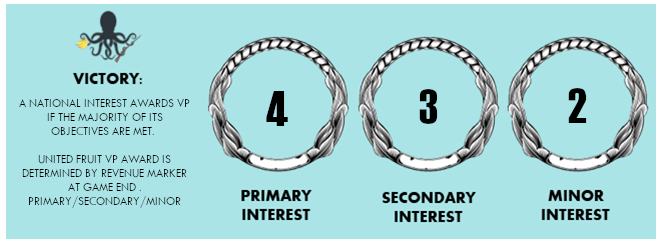
A player interest board from the prototype
Mechanically, El Pulpo builds on a long lineage of card-driven games but adds some refreshing twists. Each round, representing one decade between 1900 and 1950, players draft a hand of cards they will use on their turns. The cards all contain mandatory events, some of which will only happen once and others that will repeatedly affect the game state. Rather than action or operational points, each card slots into one of four suits: Labor, Political, Force, or Export. When you use a card, acting within its suit allows you to accomplish more than taking an off-suit action. At every step there are interesting decisions to be made, from drafting for events versus suits to the order in which you play your cards, to how you might work around getting a less than ideal draw in a round. While players have a lot of control over the game state, they are also continually subject to the historical record, through the events on everyone’s cards as well as a chronological event deck that shapes the feel of each round as the game progresses. The game requires you to navigate around these things while trying to steer the ship in your own direction.
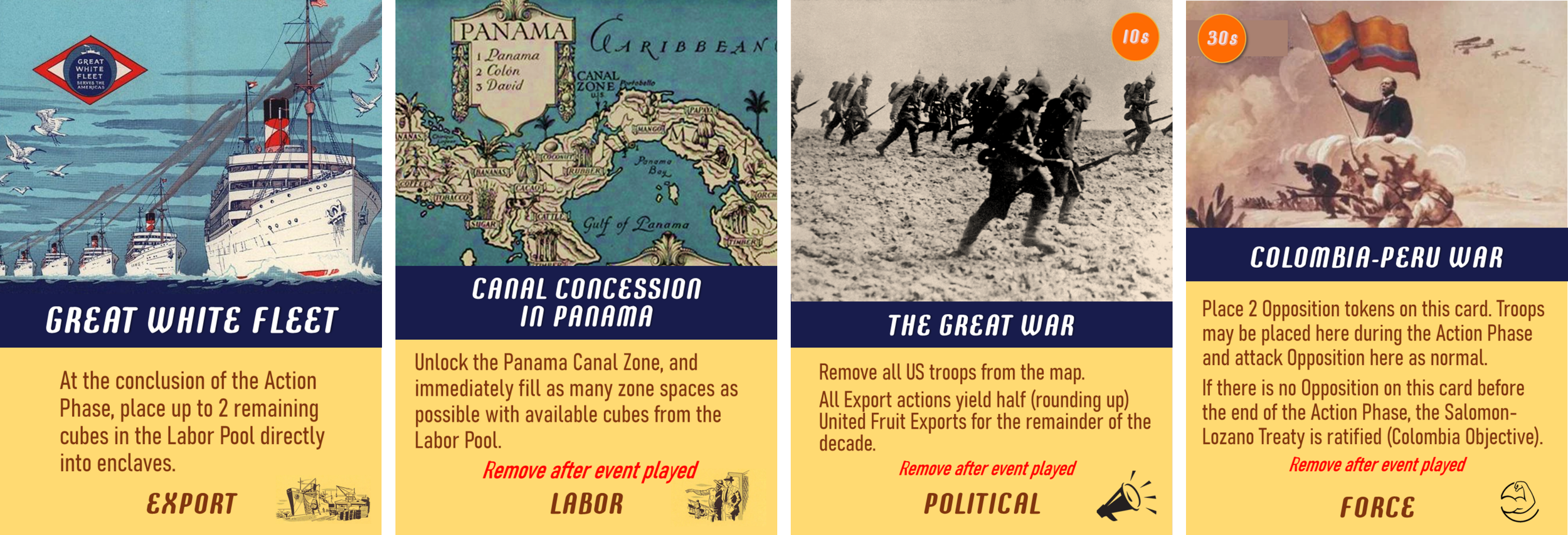
Sample event cards from the prototype
Through these interlocking mechanisms, El Pulpo delivers an incisive critique of the major actors in these events. It asks players to reflect on questions about corporate greed, the role of capital in international relations, the relationship between democratic and authoritarian governments with respect to economic principles, and the persistent legacy of slavery manifested as class-based racism in the region. Perhaps most importantly, El Pulpo asks players to consider their own roles in these events by having them occupy agents with complex interests. A player could easily end up with stakes in the fate of Honduras, the labor movement, and United Fruit itself. What does it mean to occupy the role of a person who cares about the success of all three of these things?
Ultimately, I see El Pulpo as a fascinating study of the complex drivers of human behavior that lead to horrifying events. There is not a single villain in this story — many forces, including the players at the table, have roles in the history of this region. This is what makes the game such a strong fit for Hawk & Dove and this is why we’re so pleased to have it in our pipeline for publication. El Pulpo will come to crowdfunding a little more than a year from now, in the Fall of 2027.
Read more about an earlier version of the game in this piece by Dan Thurot.
Follow along on BGG!
Subscribe to Hawk & Dove’s newsletter to get updates about this and our other games.
Thanks so much!
~Brooks
